Portland, Oregon
A Brief History of Portland
Portland is the kind of city that invites you to wander.
One minute you’re walking beneath old trees in a quiet neighborhood, and the next you’re browsing the shelves of an independent bookstore, ordering lunch from a food cart, or following a path beside the Willamette River. Forested hills frame the skyline, bridges stitch the city together, and on a clear day, Mount Hood appears in the distance like it has been waiting for you to notice.
Long before Portland became a city, the land around the Willamette and Columbia rivers was home to Indigenous peoples, including Multnomah, Clackamas, Chinook and other communities who fished, traded and gathered along these waterways for thousands of years.
American settlers established a townsite on the west bank of the Willamette River in the 1840s. According to the city’s most famous origin story, Portland received its name after Asa Lovejoy of Boston and Francis Pettygrove of Portland, Maine, settled the matter with a coin toss. Pettygrove won, and Portland was incorporated in 1851.
Its position near two major rivers helped the city grow into an important port and timber center. Railroads, shipyards and industry followed, along with waves of immigrants and workers who helped shape its neighborhoods. That growth also came with displacement, discriminatory laws and exclusionary policies whose effects remain part of Portland’s story.
Over time, Portland developed a different sort of reputation: the City of Roses, a center for environmental planning, bicycles, independent businesses, public parks, coffee, books, craft beer and wonderfully specific passions.
Today, Portland feels creative without trying too hard and outdoorsy without requiring you to leave the city. You can spend the morning hiking through a forest, the afternoon exploring galleries and gardens, and the evening eating your way through a food-cart pod.
It is a city best discovered slowly, one neighborhood/quadrant at a time.
Visitor Essentials: What to Know Before You Go
Best Time to Go
- Spring (March–May): Cherry blossoms, rhododendrons, fresh greenery and regular showers
- Summer (June–August): Warm, mostly dry days, outdoor festivals and long evenings
- Fall (September–October): Cooler walking weather, fall color and harvest season
- Winter (November–February): Rainy, quiet and ideal for bookstores, museums and coffee shops
- Best overall balance: Late May, June, September and early October
- Summer note: Check for heat waves and wildfire smoke before longer outdoor adventures
What to Pack
Portland is casual. Comfortable clothing works almost everywhere, including most restaurants and breweries.
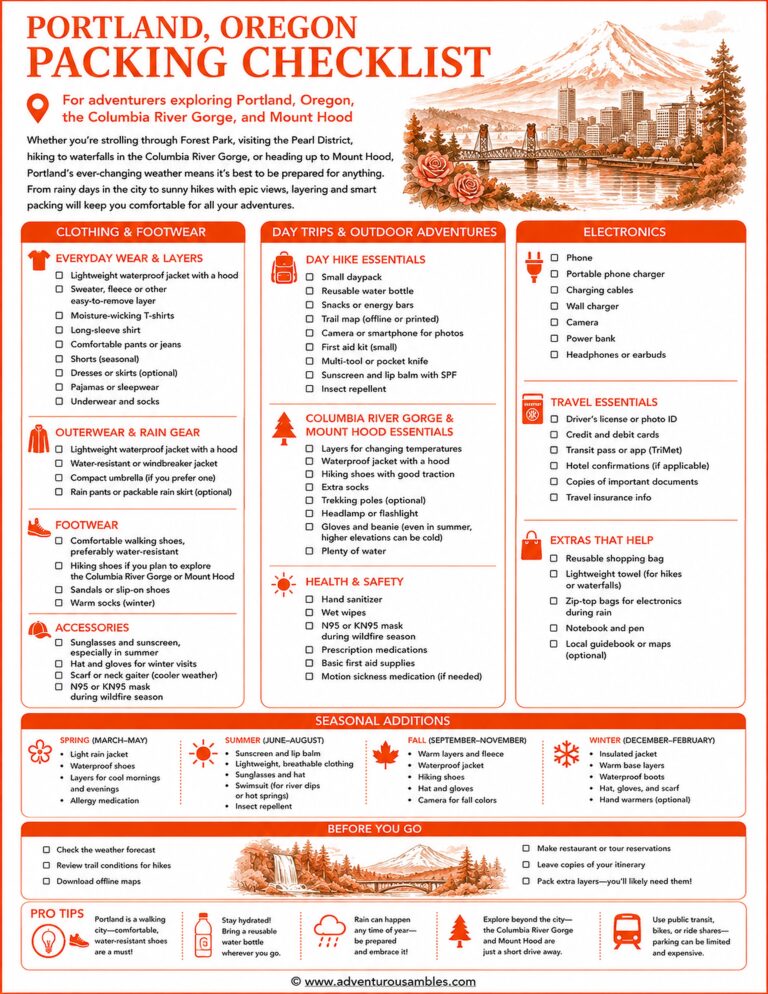
Save or print this Portland, Oregon Packing Checklist before your trip. It covers everything you’ll need for rainy neighborhood walks, sunny summer days, Forest Park trails, Columbia River Gorge waterfalls, and adventures around Mount Hood. Save it now and pack with confidence later!
Average Accommodation Costs
Typical nightly rates before lodging taxes:
- Hostels and shared rooms: $45–$85 per bed
- Budget hotels and motels: $95–$150
- Mid-range hotels: $150–$240
- Boutique and upscale hotels: $225–$375+
- Short-term rentals: Usually $140–$300+, depending on size, neighborhood and cleaning fees
Check the complete booking total for taxes, resort fees and short-term-rental cleaning fees. Portland’s combined lodging tax is 13% through December 31, 2026. The lodging tax is scheduled to increase to 14.25% on January 1, 2027.
Best areas to stay:
- Downtown: Convenient for public transportation and major attractions
- Pearl District: Walkable, polished and close to restaurants and shops
- Northwest Portland: Leafy streets, historic homes and easy access to Washington Park
- Central Eastside: Good food, breweries and easy river access
- Alberta, Mississippi, Hawthorne or Division: More of a neighborhood atmosphere
Getting Around Portland
- Walking: Best for downtown, the Pearl District, Northwest Portland and individual east-side neighborhood centers
- MAX Light Rail: Connects downtown with the airport, Beaverton, Hillsboro, North Portland, Gresham and Clackamas
- Buses: Extensive neighborhood service throughout the Portland metropolitan area. Download the PDX Transit App.
- Portland Streetcar: Useful for downtown, the Pearl District, South Waterfront and Central Eastside
- Bicycle: Neighborhood greenways and riverfront paths make Portland one of the easiest U.S. cities to explore by bike
- Car: Helpful for regional day trips but usually unnecessary for central Portland
- Rideshare: Uber, Lyft , Wingz, and traditional taxis are widely available
Transit essentials:
- TriMet operates MAX trains and buses
- Portland Streetcar operates the city’s streetcar loops
- Adult TriMet fare is currently $2.80 for 2½ hours; Adult daily fare is capped at $5.60
- Pay with a contactless bank card, mobile wallet or Hop card
- Use the TriMet Trip Planner for routes and live arrivals
- Download the Hop Fastpass app to manage transit fares
Cycling and parking tools:
- BIKETOWN offers standard and electric-assist bike sharing
- Parking Kitty lets you pay for many metered parking sessions by phone
- Watch for bicycles, one-way streets and streetcar tracks when driving
- Never park on or too close to streetcar tracks
- Avoid leaving luggage or valuables inside a parked vehicle
Nearby Spots Worth Exploring
- Columbia River Gorge: Waterfalls, viewpoints and forest trails beginning approximately 30 minutes east of Portland
Check Ready, Set, GOrge for permits and seasonal restrictions
Car-free travelers can use the Columbia Gorge Express
- Hood River: Approximately 1 hour east
- Mount Hood: Approximately 1½–2 hours southeast
- Willamette Valley Wine Country: Approximately 45–90 minutes southwest
- Oregon Coast: Approximately 1½–2 hours west
Frequently Asked Questions
Does Portland Have Sales Tax?
No. Oregon does not have a general sales or transaction tax, so the shelf price is usually the amount you pay for ordinary retail purchases.
There are exceptions and separate taxes, including lodging taxes and certain vehicle-related taxes. If you cross the river into Washington, local and state sales taxes apply there.
Does It Really Rain All the Time?
No but Portland does have a long wet season.
Most rain falls between autumn and spring, often as light showers or steady drizzle rather than dramatic downpours. Summers are usually warm and dry. The rain is also responsible for the mossy forests, enormous trees and exuberant gardens that make the city feel so green.
Bring a waterproof layer and keep exploring. Portland does not tend to stop for drizzle.
Do I Need a Car in Portland?
Not for most city visits.
Downtown, the Pearl District and many inner neighborhoods are accessible by walking, MAX, bus, streetcar or bicycle. A car becomes much more useful for reaching Mount Hood, the Oregon Coast, wineries and less accessible trailheads.
A good compromise is to explore Portland without a vehicle and rent one only for regional day trips.
How Many Days Should I Spend in Portland?
Three days gives you enough time to explore several neighborhoods, visit a garden or museum, eat at a few food-cart pods and take a walk through Forest Park.
Four or five days allows for a more relaxed pace and at least one day trip to the Columbia River Gorge, Mount Hood, the Oregon Coast or wine country.
Portland rewards unplanned time, so leave a little room for the bookstore, café, garden or neighborhood you did not know you were going to love.
Is Portland Safe for Visitors?
Most visitors explore Portland without serious problems, but normal city awareness is important.
Keep valuables out of sight, do not leave luggage in a parked car and pay attention to your surroundings late at night. Conditions can vary from block to block, particularly around parts of Old Town–Chinatown. If an area feels uncomfortable, move toward a busier street or use a taxi or rideshare.
For current neighborhood information, closures and local guidance, consult Travel Portland.
Wander Through Portland One Neighborhood at a Time
What makes Portland memorable is not a single landmark.
It is the path through Washington Park when everything smells like cedar. The tiny gallery you almost walked past. The first glimpse of Mount Hood between buildings. A bowl of something wonderful eaten at a picnic table beside a food cart. The bookstore where you meant to spend twenty minutes and somehow lost an entire afternoon.
Portland is at its best when you stop trying to see all of it.
Choose a neighborhood. Follow the greenway. Cross a bridge. Take the long route through the park. Let the rain tap against your jacket for a while.
There is always another trail, garden, coffee shop or curious little corner waiting around the next block.
And that is exactly what makes Portland such a good city for an adventurous amble.
More Adventurous Ambles in Portland
The stories behind the
City of Roses
Portland Reading List